

5 Governance Mistakes That Kill Projects

Updated: Aug 4
And the practical fixes that actually work
"Projects do not collapse suddenly. They deteriorate slowly — and almost always, governance is where the rot begins."
Globally, nearly one in four projects fails to meet its objectives — not because of the technology, not because of the team, but because of the governance framework holding it all together. After three decades working in enterprise technology delivery, one pattern emerges with striking consistency , the seeds of project failure are planted early and quietly, long before a missed deadline or a budget breach surfaces.
This article breaks down the five governance mistakes I see most often — and what leaders can do right now to fix them.
By the Numbers: The Cost of Weak Governance
~26% | Projects that fail to meet their business objectives (PMI Pulse of the Profession 2024) |
11% | Average project investment lost due to poor performance and weak governance |
46% | Projects that remain within their original budget |
48% | Projects that can be classified as fully successful — barely half |
Mistake 1: Unclear Ownership and Accountability
Walk into most struggling projects and you will find the same scene: a project manager, a technical lead, a business owner, and a steering committee — none of whom can tell you, without hesitation, who is authorised to make a given decision. When accountability is diluted, problems wait. No one wants to step on toes. Issues escalate slowly, and by the time they reach the right person, the cost of resolution has multiplied.
Accountability gaps do not just slow decisions — they create the conditions for blame, disengagement, and quiet failure.
The fix
Two tools (and not limited to) used together, eliminate most accountability confusion:
Project Charter (initiation stage): Define roles, decision-making authority, and escalation hierarchy in writing — before the project kicks off, not after the first crisis.
RACI Matrix: Each task has a single Accountable owner. Responsibilities are explicit. Stakeholders know both what they own and what they do not.
Document decision rights for three critical areas specifically: scope changes, resource allocation, and risk mitigation. Governance works not when responsibilities are assigned, but when ownership is so clear that no one needs to ask.

Mistake 2: Governance Forums That Discuss But Never Decide
Many organisations run excellent meetings that produce very little. Steering committees meet fortnightly. Status dashboards are polished and on time. Yet the same issues appear on the agenda week after week, slightly rephrased. This is one of the most expensive governance failures — not because decisions are wrong, but because they simply do not get made.
Delayed decisions create schedule slippages and resource bottlenecks. Worse, they signal to delivery teams that escalation is pointless, so issues stop getting raised at all.
A governance body that discusses without deciding is a delay mechanism dressed as oversight.
The fix
Redesign governance forums around outcomes, not agendas:
Every meeting should close with a clear decision, assigned actions, and defined deadlines. If it cannot produce these, the meeting should not have been held.
Steering committees should focus on strategic escalations — not operational updates. Operational updates belong in project status reports, not boardrooms.
Consider AI-driven or Power BI-based or any other tool based escalation mechanisms that proactively surface unresolved risks, track ownership, and trigger alerts before issues become crisis.
Governance effectiveness is measured not by meeting frequency but by decision velocity.

Mistake 3: Risk That Sits in a Register and Goes Nowhere
Risk registers are among the most universally adopted — and most frequently ignored — tools in project management. Risks get logged diligently. They are reviewed in weekly status calls. And then they sit, unchanged, until they become issues.
The deeper problem is cultural. Teams often attempt to resolve risks internally to avoid appearing unprepared. This is understandable. It is also how small, manageable risks become executive-level emergencies.
The goal of a risk register is not to document what might go wrong. It is to trigger action before it does.
The fix
Build a culture where early escalation is rewarded, not penalised. Then back it up with better tools:
Move beyond static risk registers. Integrate delivery data from platforms like Jira or Trello and apply predictive analytics to anticipate schedule overruns and emerging risks before they materialise.
Use heat maps and real-time dashboards not as reporting artefacts but as live governance instruments — visible to senior stakeholders, updated continuously.
Shift the question from 'What went wrong?' to 'What signals are we seeing now?' Predictive risk management turns governance from reactive to preventive.

Mistake 4: Mistaking Reporting for Insight
There is a particular kind of governance maturity trap where teams become extraordinarily good at producing reports that say very little. RAG status updates. Weekly slide decks. Detailed milestone trackers. All accurate. All on time. And all telling leadership almost nothing about the true health of the programme.
When governance focuses on reporting metrics rather than interpreting them, the early warning signals — declining team velocity, creeping scope, mounting technical debt — get buried under green RAG statuses.
Green on a dashboard and healthy in delivery are not the same thing. Governance must close that gap.
The fix
Transition from static reporting to dynamic visibility:
Build CIO-level governance dashboards that provide real-time programme health indicators, predictive risk signals, and trend-based performance insights — not just point-in-time snapshots.
Shift governance discussions from 'Are we on track?' to 'What does the data tell us about where we are heading?'
Automate alerts for deviations. Decision-makers should not have to read a 40-slide deck to learn that a workstream is in trouble.
The goal is continuous visibility — a centralised digital ecosystem where insight is always current and decision-makers are never flying blind.

Mistake 5: Letting Projects Drift from Strategic Purpose
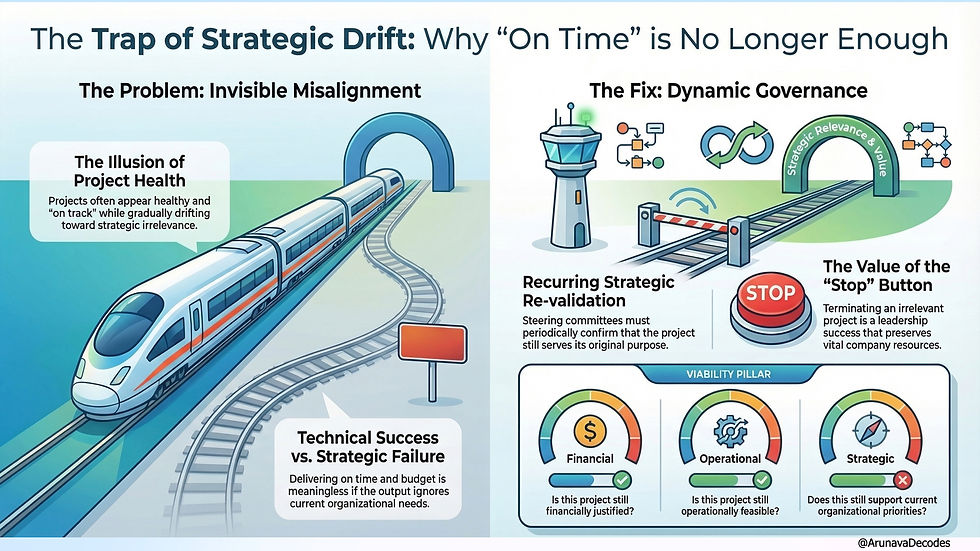
Projects rarely fail dramatically. More often, they succeed at delivering something that no longer matters. Scope expands, priorities shift, stakeholder demands accumulate — and gradually, the project delivers outputs that are technically complete but strategically irrelevant.
This kind of misalignment is particularly costly because it is invisible until the end. The project appears healthy throughout delivery. The problem only surfaces at benefits realisation, when everyone realises the business has moved on.
Delivering on time and on budget means nothing if what you deliver is no longer what the organisation needs.
The fix
Strategic alignment must be a recurring governance checkpoint, not a one-time initiation exercise:
Steering committees should periodically re-validate that the project still serves its original strategic purpose — and have the authority to course-correct when it does not.
Build formal decision points where sponsors assess continued viability: Is this project still financially justified? Is it still operationally feasible? Does it still support the organisation's current priorities?
And critically — be willing to stop. Terminating a project that has lost strategic relevance is not a failure. It is one of the most valuable governance decisions a leadership team can make. It preserves resources, protects credibility, and redirects capacity to work that actually matters.
Strong Governance Is What Separates Projects That Deliver from Those That Drift
Governance is not bureaucracy. It is the operating system that connects strategic intent to delivery reality. When it works, projects adapt to change, risks surface early, decisions get made, and value is delivered. When it fails, the consequences are measurable.
Organisations that consistently deliver share several characteristics: clearly defined decision authority, transparent risk practices, data-driven performance insights, and leadership that is genuinely engaged — not just nominally informed.
The five mistakes above are common. But they are also fixable. The organisations that fix them do not just deliver more projects successfully — they build the institutional capability to keep doing so.
Which of these five mistakes is most present in your organisation right now?
I would be interested to hear what patterns others are seeing — share your experience in the comments.
About the Author
Arunava Chakravarty has spent three decades working in enterprise technology delivery across large organisations, specialising in programme governance, AI-assisted decision systems, and delivery performance analytics.


Comments